Latest News
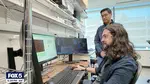
FOX 5 Atlanta featured the lab’s BCI work in a story on the BrainGate clinical trial at Emory and Georgia Tech: Emory and Georgia Tech trial helps paralyzed patients speak. The segment talks with Dr. Pandarinath and Dr. Nicholas Au Yong about using small intracortical sensors and AI to translate intended speech into text for people who cannot communicate verbally.
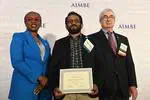
Dr. Pandarinath was elected to the American Institute for Medical and Biological Engineering (AIMBE) College of Fellows as part of the Class of 2026, recognized for “outstanding contributions to computational neural engineering through the development of gold standard methods of latent space analysis.” The formal induction ceremony was held in Arlington, VA on April 13, 2026.
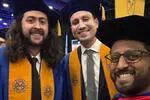
A big week for the lab: back-to-back PhD defenses in Biomedical Engineering at Emory and Georgia Tech. Mattia Rigotti-Thompson defended on Feb 9, 2026, followed by Yahia Ali on Feb 13, 2026. Congrats Dr. Rigotti-Thompson and Dr. Ali !!!
Dr. Pandarinath was the guest on Reverse Mind Control, an episode of Holy Shift! Biomedical Breakthroughs Shaping Tomorrow — the Wallace H. Coulter Department of Biomedical Engineering’s podcast, hosted by Angela Gill Nelms. The episode walks through how the lab reads brain signals, what brain-computer interfaces can do for people with paralysis today, and what the future of mind-powered technology could look like.
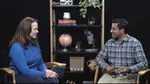
Dr. Pandarinath joined Laurel Bristow on Health Wanted, Atlanta NPR (WABE)’s public-health podcast, for an episode on brain-computer interfaces. The conversation covers how BCIs work, what the technology can do for people with paralysis today, and where the science is headed.

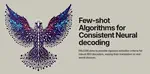
At NeurIPS 2024, Brianna Karpowicz and Joel Ye presented the new Few-shot Algorithms for Consistent Neural decoding (FALCON) Benchmark. FALCON aims to provide rigorous selection criteria for robust intracortical brain-computer interface (iBCI) decoders, easing their translation to real-world devices. The project evaluates decoding algorithms based on their stability for held-out neural data (unseen during decoder training), with the goal of developing algorithms that achieve stable iBCI decoding over weeks, with minimal data collected on new days. The project includes diverse datasets (five curated datasets that span movement and communication iBCI tasks in humans and primates). With the help of AE Studio, we developed a flexible, cloud-based evaluation platform that tests approaches on private neural data.
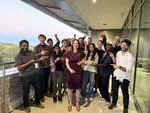
Brianna Karpowicz successfully defends her PhD in Biomedical Engineering at Emory and Georgia Tech. Congrats Dr. Karpowicz !!!
At SfN 2024, Chethan Pandarinath, Nicholas Au Yong, and Rune Berg organized the first-ever minisyposium on population dynamics in the spinal cord at SfN 2024. The workshop, entitled “Unveiling the Neural Dynamics Underlying Movement and Respiration in the Spinal Cord and Medulla”, brought together leaders in the nascent (but rapidly growing) field of population recording in the cord.
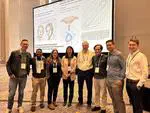
At Cosyne 2024, Chris Versteeg and Chethan Pandarinath organized the workshop “Understanding Neural Computation using Task-Trained and Data-Trained Networks”. The workshop aimed to connect two major methodologies for using dynamics to bridge from neural activity to neural computation – task-trained and data-trained network modeling – and foster communication between researchers in both sub-disciplines.