Abstract
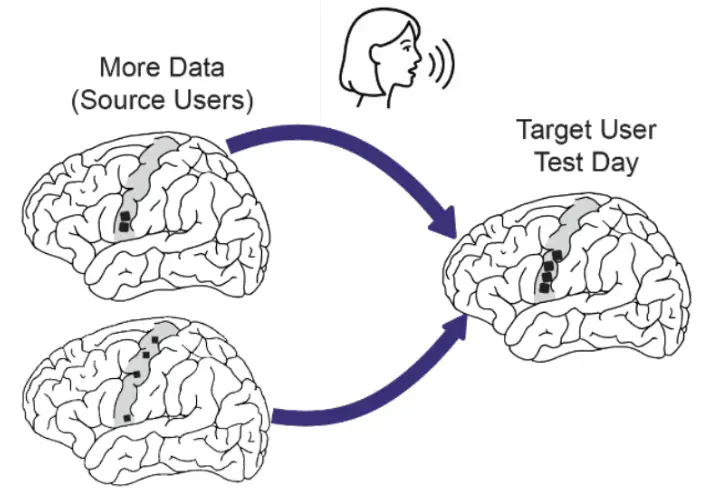
Intracortical brain-computer interfaces (BCIs) that decode complex movements, such as handwriting and speech, can require substantial training data to achieve high performance. We investigated whether leveraging the neural activity recordings of previous users could reduce this initial data collection burden for new BCI users (an approach we call “cross-brain transfer”). Using intracortical recordings from five BrainGate2 clinical trial participants, we tested cross-brain transfer for both speech and handwriting neural decoders trained and evaluated on general, unconstrained corpora of spoken and written English. We found that cross-brain transfer improved decoding performance when training data from the target user was limited (< 200 sentences), and that dataset-specific input layers to the decoder were critical for combining data across users. Without trainable input layers, transfer failed and performed worse than training from scratch on target user data only. Finally, we measured the effectiveness of cross-brain transfer relative to training with (1) more data from the same user and (2) more electrode-permuted data from the same user, which simulates sampling from another brain with identical neural latent structure. In some cases (T16 speech, T12 handwriting), cross-brain transfer appeared as effective as additional permuted data from the same user, while in others (T12 speech, T15 speech) electrode-permuted data was more beneficial. Our results successfully demonstrate and characterize cross-brain transfer learning between multiple intracortical BCI users, for both speech and handwriting, using a general open-ended dataset not restricted to small sets of words or phrases. This work highlights a promising path towards addressing a key barrier to the clinical translation of BCIs, while clarifying when cross-brain transfer may be most beneficial and the decoder design choices needed to realize those gains.