Pseudo-linear summation explains neural geometry of multi-finger movements in human premotor cortex
Abstract
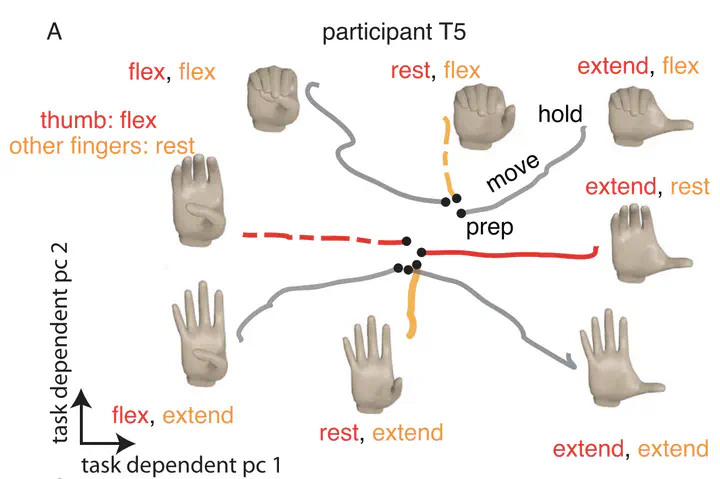
How does the motor cortex combine simple movements (such as single finger flexion/extension) into complex movements (such as hand gestures, or playing the piano)? To address this question, motor cortical activity was recorded using intracortical multi-electrode arrays in two male people with tetraplegia as they attempted single, pairwise and higher-order finger movements. Neural activity for simultaneous movements was largely aligned with linear summation of corresponding single finger movement activities, with two violations. First, the neural activity exhibited normalization, preventing a large magnitude with an increasing number of moving fingers. Second, the neural tuning direction of weakly represented fingers changed significantly as a result of the movement of more strongly represented fingers. These deviations from linearity resulted in non-linear methods outperforming linear methods for neural decoding. Simultaneous finger movements are thus represented by the combination of individual finger movements by pseudo-linear summation. Here, the authors show that Intracortical recordings in human motor cortex during attempted multi-finger movements reveal a largely linear code with two violations: magnitude normalization and greater shifts in tuning direction for weakly represented fingers.